
API credentials
An integration authenticates as the company space, not as a person. The credentials it uses are issued here, under organisation settings.
Verified: Captured from
#/csPreferences/apiCredentials on 2026-09-04 by
issuing a credential and revoking it again.Issuing one
Section titled “Issuing one”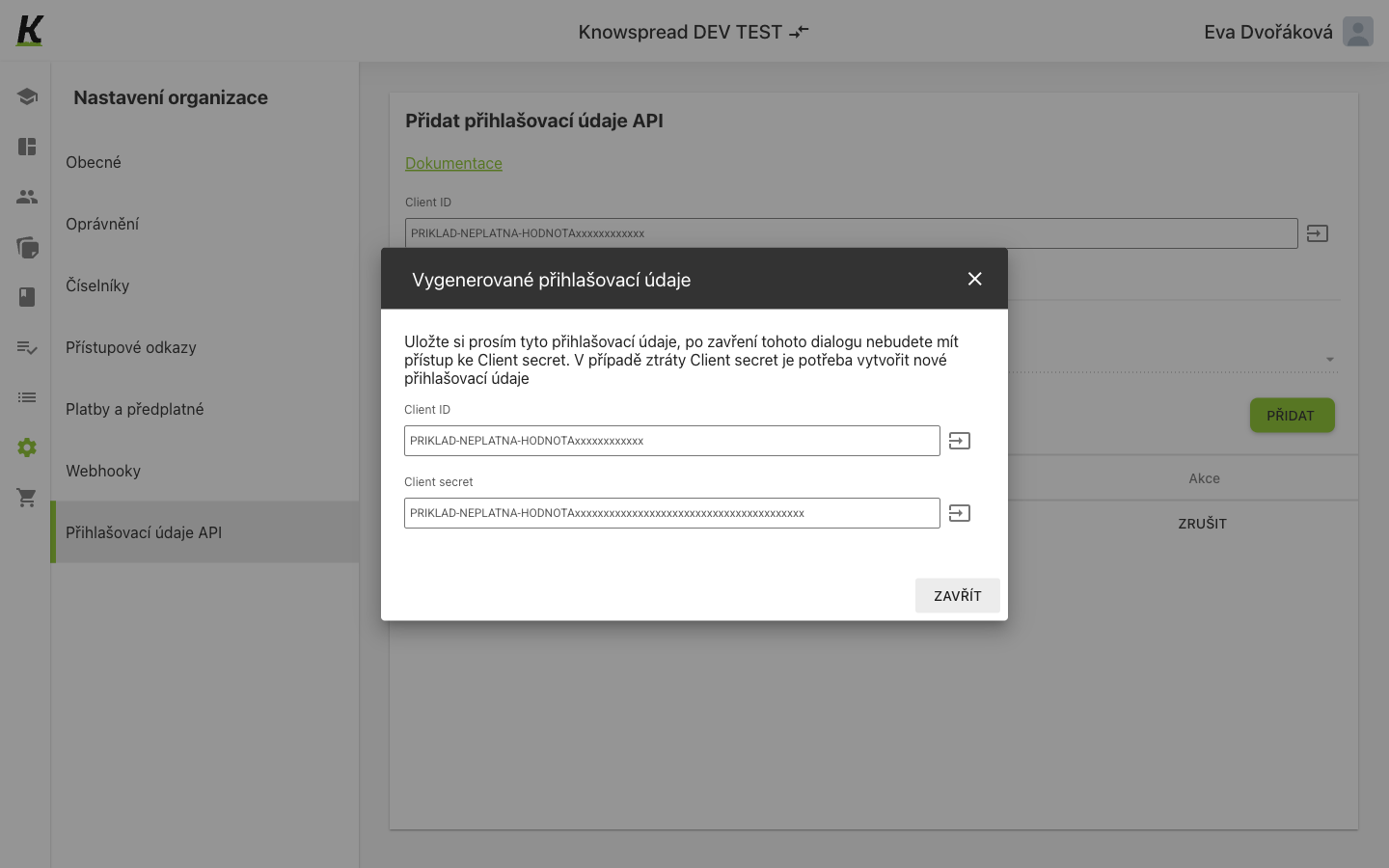
123
- Give the credential a name, choose the API version and select Přidat. The dialog appears immediately, carrying the Client ID (1).
- Below it is the Client secret (2). Both have a copy button.
- Zavřít dismisses the dialog (3) — and that is the moment the secret becomes unavailable.
The secret is shown once
Section titled “The secret is shown once”Fact: The dialog says so plainly: after it closes you no longer have access
to the Client secret, and losing it means creating a new credential. Copy it
before closing.
Fact: The space has a Client ID of its own, visible on the screen even
before any credential exists. The ID identifies the space; the secret is what
each issued credential adds.
Fact: Removing a credential is a revoke, not a delete — the action
calls
POST /api/v1/company_spaces/api_credentials/{id}/revoke.What the credential is for
Section titled “What the credential is for”Fact: The pair is what
POST /rest/v1/auth/token expects as client_id
and client_secret. It returns a bearer token for the REST API — see
authentication for the exchange itself.Fact: The credential belongs to the company space, so it carries the
space’s access rather than any one person’s. Removing a colleague’s account
does not revoke it.
Fact: In a personal space this screen shows Nemáte žádné přihlašovací
údaje because
GET /api/v1/company_spaces/api_credentials answers 403 — an
empty state standing in for a refusal. See access links
for the same pattern.